

Quantifying Operational Friction In High Debt Engineering Teams
Operational friction measures technical debt as an ordinal vector of context switching hours, execution delays, and cognitive attention loss.
Operational friction measures technical debt as an ordinal vector of context switching hours, execution delays, and cognitive attention loss.
Finite liquidity constraints force optimization algorithms to prune state space dimensions permanently, trapping systems on lower-dimensional manifolds.

Latent risk gradients quantify how distributed execution manifolds divert state changes into unevaluated paths, building unspent volume above system baselines.
Trajectory collapse forces unspent energy into secondary dissipation vectors, requiring operators to map friction boundaries and mirror latent volume.
Delivery stress forces operational systems to abandon high-dimensional architectural options, compressing initial state space along paths of least resistance.

Computing directional divergence metrics across autonomous units projects division outputs against baseline vectors to measure operational separation in degrees.

Operational divergence is resolved by calculating cross-layer vector transformations and applying gradient realignment to friction coordinates.
Operational slope variation measures changing effort per progress unit across baseline workflows to locate systemic friction points.

Hurdle gradient spikes measure the instantaneous rate of change in required returns during capital restructuring windows.

Computing directional gradient vectors derives continuous rates of value variance across multi-dimensional surfaces to guide movement beyond flat quadrants.

Truncating evaluation windows forces parameter descent into shallow local minima by penalizing the transient losses necessary for structural adaptation.

Operational capacity remains latent when teams deflect down low-friction lateral paths, leaving an unspent volume calculable by decomposing the diverted vector.

Mapping relative performance across autonomous business units converts local ordinal rank into unified directional vectors without forcing cardinal metric alignment.

Corporate asset deployment efficiency depends on mapping non-linear operational boundary limits rather than relying on cardinal balance sheet valuations.

Capacity loss signals manifest as uncounted manual workarounds and signal damping long before reported throughput metrics show execution loop failure.
Sustained execution stress forces operational systems into low-energy default states, contracting reachable execution options to local historical paths.

True operational intent is isolated by measuring work trajectory deviations around unseen spatial friction rather than trusting stated strategic goals.

Engineering teams route operational expansion around core database constraints by building peripheral wrapper services, accumulating hidden coordination friction.

Unbounded stress contracts the operational state manifold, forcing system decisions into low-energy deterministic paths along the path of least resistance.
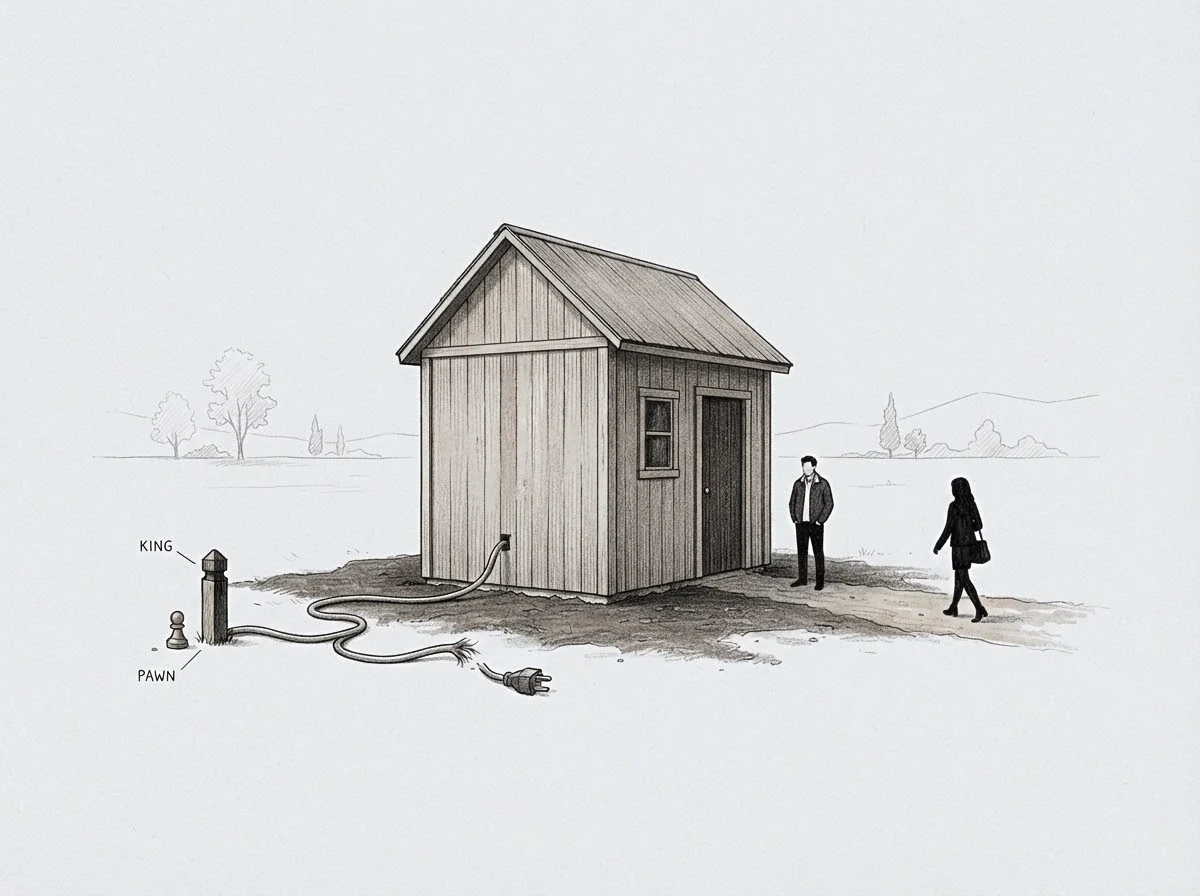
Vector divergence measures the angular offset between executive strategic trajectories and peripheral resource allocation along a derived value axis.
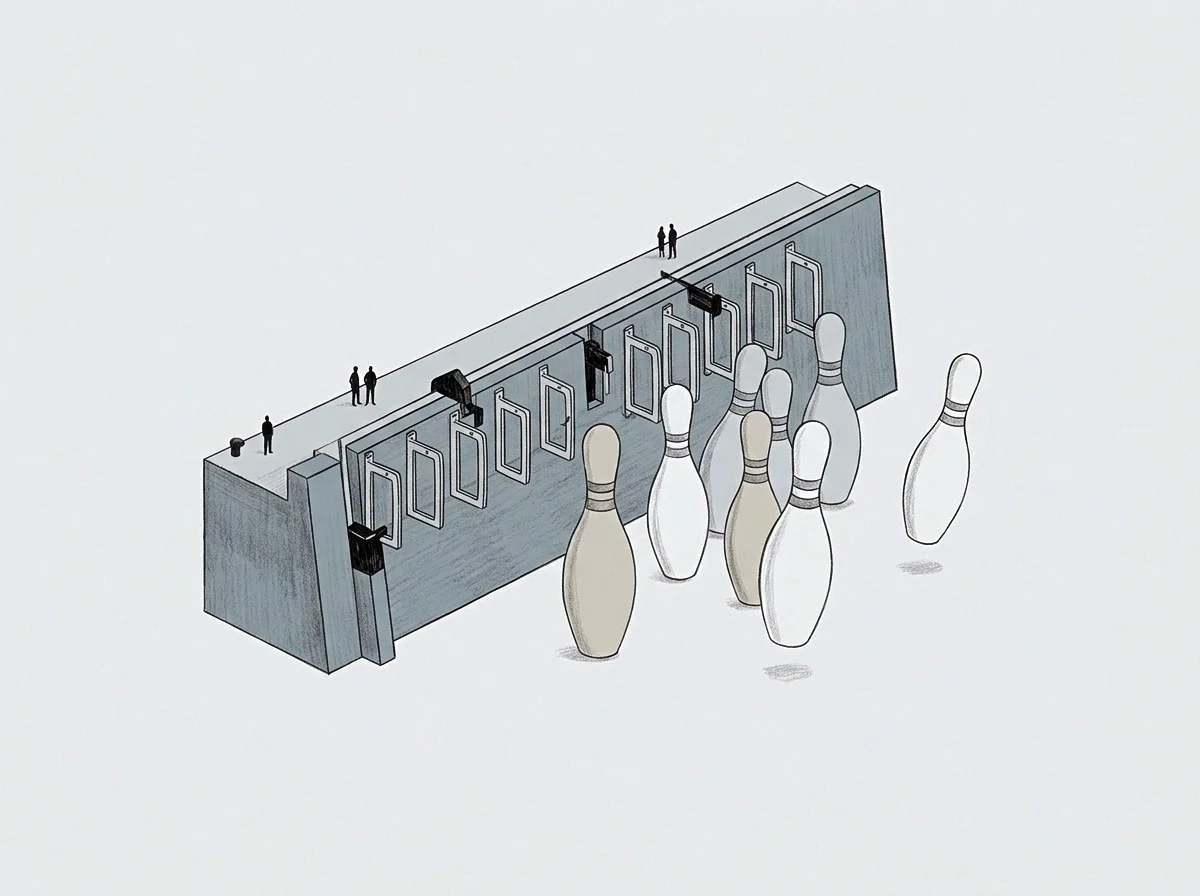
Capital allocation models reach systemic boundaries when non-linear operational friction causes realized returns to diverge from latent value potential.

Continuous marginal value measurement replaces ordinal planning matrices by mapping incremental capital allocation against mathematical value derivatives rather than static scorecard ranks.
Measuring capital allocation through cardinal value gradients maps the derivative of returns against deployed liquid reserves along a continuous mathematical axis.

A gradient computed from value measures directional change along an established coordinate without introducing qualitative assessment or moral judgment.
The terms are written where they belong. Each field holds three desks, and every entry a desk writes raises the terms it uses, each term given a meaning, a mechanism and the places it appears. The record on these pages stays first person and hand made; the fields grow the nomenclature.